Guthrie
Killers of the Flower MoonGuthrie became a pivotal setting in the federal response to the Osage murders, first as the place where Ernest Burkhart was jailed and interrogated, then as the courtroom city for the trial of William K. Hale and John Ramsey over Henry Roan’s murder. Its jail and courthouse brought the investigation’s private questioning and public reckoning into close proximity, while the proceedings exposed how questions of racial justice shadowed the search for a verdict.
Arrests and Interrogation
After his arrest in Fairfax, Ernest Burkhart was transported about eighty miles southwest to the jail in Guthrie. Hale could not initially be found, and authorities feared he had left town; instead, he appeared at Sheriff Harve M. Freas’s office and surrendered. He was taken to the Guthrie jail in a sharply pressed suit, polished shoes, felt hat, and an overcoat bearing a diamond-studded Masonic lodge pin. A local reporter described his movement as that of a leashed animal.
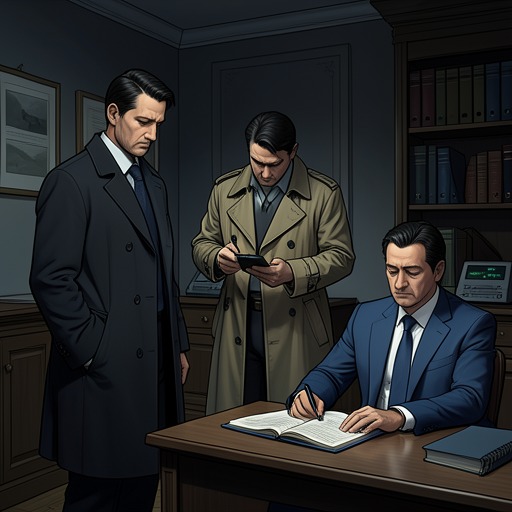
The questioning moved from the jail to a makeshift interrogation room on the third floor of a federal building in Guthrie. Thomas B. White and Agent Frank Smith questioned Burkhart there. White regarded him as the likelier of the two suspects to confess: Hale, he believed, would not admit his crimes, whereas Burkhart might be persuaded to speak. At first Burkhart denied knowing anything about the murders of Bill Smith’s family and Anna Brown. The room known as the box thus became the setting for an interrogation that tested whether the investigation could break through his denial.
The Courthouse and the Roan Trial
In the last week of July 1926, Hale and Ramsey’s trial for Roan’s murder opened at Guthrie’s redbrick courthouse. The heat was oppressive: the temperature outside reached ninety degrees, and the crowded courtroom was difficult to breathe in. Spectators arrived early to secure seats as John Leahy, the prosecutor, outlined the charges: Hale was accused of aiding and abetting the killing, while Ramsey was charged with carrying it out. Hale smiled slightly as the case began; Ramsey leaned back, fanning himself, a toothpick between his teeth.
The trial followed Burkhart’s confession in the Smith murder conspiracy, which implicated Hale. A Tulsa newspaper cast that earlier proceeding as a prologue to the Roan case, emphasizing the scale and anticipation surrounding the Guthrie trial. White increased guards at the jail after attempts to break out outlaws expected to testify against Hale. While detained on a separate tier from Blackie Thompson, Hale passed him a note through a hole around a radiator pipe and offered to arrange his escape if Thompson would not testify and would make Burkhart disappear before he could take the stand. Guthrie’s jail was therefore not merely a place of confinement: it was also where the prosecution faced efforts to interfere with its witnesses.
A Trial Shadowed by Race
The courthouse proceedings raised a question that the judge, prosecutors, and defense did not put directly to the jurors: whether twelve white men would punish a white defendant for killing an Osage person. A reporter remarked on the established attitude of pioneer cattlemen toward full-blood Indians; an Osage observer challenged the premise more starkly, questioning whether the jury was deciding a murder case or treating the killing of an Osage as cruelty to animals. The trial’s formal setting and legal procedure could not separate the question of guilt from the racial hierarchy surrounding it.
Guthrie’s significance in the book rests on this convergence of places and pressures. The jail held suspects and endangered witnesses; the federal building contained the interrogation room where Burkhart was pressed to speak; and the courthouse turned the accusations into a public test of evidence, testimony, and justice. The city’s role was not simply logistical: its rooms gave the investigation a route from arrest to confession and from accusation to trial, while the racial doubts voiced outside the jury’s oath remained present within the proceedings.